
These online platforms streamline the editing of cumbersome drafts. Requiring either a quick online spell verification or an in-depth grammatical review, offerings from LanguageTool, Grammarly, and Scribens scrutinize texts for grammar, punctuation, and stylistic elements within moments.
Integration with browsers and applications enables on-the-spot adjustments during writing. LanguageTool identifies the language and recommends alternatives for more lucid expressions. Grammarly introduces tone evaluations, alterations in sentence construction, and features for corporate governance. Scribens delivers potent complimentary scans and lucid justifications for errors identified.
The fundamental guarantee is straightforward: these automated tools enhance the fundamental quality of writing while economizing time. Whether for email correspondence, reports, social media updates, or academic assignments, they identify and rectify errors prior to public disclosure.
Why Online Text Correction Tools Matter for Modern Writers
In the current fast-paced literary environment, writers must manage drafts, emails, and social media updates on stringent deadlines. Grammar checking tools, such as LanguageTool, provide immediate error detection. They offer real-time correction suggestions in emails and posts. This functionality accelerates the transition from concept to publication.
Online writing aids offer significant advantages to both teams and individual content creators. They eliminate the need for repeated editing sessions. Grammarly, for example, not only identifies elementary mistakes with its complimentary version but also enables sentence restructuring and voice modification through its premium offerings. This significantly diminishes the time spent in revision loops.
Mistakes in casual correspondences and formal reports can undermine professionalism. Scribens identifies and corrects over 90% of grammatical and spelling errors. Its integration with Gmail and Outlook streamlines the editing process, ensuring communications are polished before reaching a wider audience.
Revolutionary AI-driven editing tools surpass basic typo corrections. They propose punctuation enhancements, clearer expression, and alternative phrasings. Consequently, writers produce more refined drafts without dedicating additional hours to revisions. This technological advancement promises elevated writing standards.
Moreover, these platforms serve an educational purpose by elucidating errors. Through detailed clarifications, users become acquainted with grammatical regulations, leading to a decrease in recurring errors. Gradually, the dependence on manual proofreading decreases, supplanted by consistent editing routines. These routines are fostered by the sophisticated capabilities of online correction tools.
How Grammar Check Tools Work: AI, Rules, and Language Models
Modern writing assistants utilize a combination of fixed grammar rules and machine learning for identifying and amending errors. They employ pattern matching and neural language models for suggesting amendments, rewriting options, and clarifying issues. This integration enhances auto-correction functionality across various platforms, including browsers, documents, and mobile applications.
Rule-based engines identify indisputable errors such as subject-verb disagreement, punctuation mistakes, and improper capitalization. Language tool meticulously employs predefined rules to target incorrect plural forms, misplaced commas, and stylistic inaccuracies. This structure is notably effective for addressing predictable mistakes and providing users with succinct explanations.
Conversely, machine learning frameworks utilize expansive datasets and models to contextualize and recommend textual modifications. Grammarly leverages such models and systems for sentence-level restructuring, detecting tonal variations, and customizing suggestions based on brand. These methodologies surpass the limitations of stringent rules, particularly in subtlety and phrase construction.
Multilingual capabilities enhance tools by incorporating automatic language recognition, allowing corrections to adhere to locale-specific standards. Platforms supporting multiple languages adaptively switch between rule sets and models. Consequently, they maintain accuracy across languages such as American English, British English, French, and Spanish, conforming to each language’s spelling and grammar conventions.
AI-enhanced syntactic identification broadens the scope of error detection by analyzing sentence architecture. Scribens integrates AI-driven syntax analysis with detailed explanations for conjugation and agreement errors. This technique effectively identifies homophones, punctuation inconsistencies, and typesetting mistakes, facilitating educational feedback for users.
Despite variances in technology, certain error categories are universally targeted. They include grammatical errors concerning agreement and conjugation, spelling errors like typographical mistakes and homonym confusion, punctuation issues including incorrect use of commas, dashes, and hyphens, and style issues such as redundancy, poor word selection, and inconsistent capitalization.
The comparative analysis below delineates the distinctions between rule-based systems and ML-driven approaches, spotlighting the specific errors each is adept at identifying. Utilize this table to discern the strengths when selecting a text correction tool or service for automatic text refinement.
| Approach | Strengths | Typical errors caught | Best for |
|---|---|---|---|
| Rule-based (example: LanguageTool) | Clear explanations, precise grammatical rules, consistent fixes | Subject-verb agreement, plural forms, punctuation, casing | Users who prefer predictable corrections and educational insights |
| Machine learning (example: Grammarly) | Contextual suggestions, nuanced tone adjustments, comprehensive sentence restructuring | Complexities in sentence construction, phrase optimization, tonal adjustments, flow discrepancies | Authors seeking fluid style enhancements and tailored recommendations |
| Syntactic AI (example: Scribens) | Robust syntactic analysis, concise error descriptions, extensive detection range | Issues with conjugation and agreement, homophones, punctuation inaccuracies, typesetting errors | Individuals requiring in-depth syntactic analysis and feedback |
| Multilingual models | Effortless recognition of languages, seamless handling of regional variations | Spelling and grammar peculiar to certain locales, punctuation specific to regional standards | Organizations creating content in diverse languages |
Top Features to Look For in an Online Text Correction Tool
Choosing the ideal online text correction tool requires weighing various factors. These include speed, assistance with stylistic elements, and privacy protections. It’s crucial to select features that align with your writing needs, encompassing emails, blog entries, or promotional content. This careful selection enables reliable support for writing online while safeguarding your documents.

Real-time suggestions and browser integrations
Obtaining immediate feedback is crucial for identifying errors as you write. Services like Grammarly and LanguageTool offer this feature directly in browsers such as Chrome, Firefox, and Edge. By employing these extensions, you can detect grammatical, punctuation, and stylistic errors instantly. This efficiency minimizes the need for subsequent revisions, facilitating quicker content publication.
Paraphrasing, tone detection, and style suggestions
Modern tools offer advanced paraphrasing capabilities, ensuring your sentences remain impactful without diluting their essence. Grammarly enhances this with tone recognition and adjustable brand voice settings in its premium offerings. LanguageTool highlights and proposes alternatives for repetitive expressions. Scribens permits varied tonal adjustments in its premium version, allowing for easy transitions between informal and formal registers. These enhancements elevate a standard editing tool into comprehensive support for writers online.
Privacy, data handling, and whether text is stored
When editing sensitive content, privacy becomes paramount. It’s important to verify if a service retains texts and the security measures for data in transit. LanguageTool, through its browser extension, asserts that it does not keep user text. Scribens secures data using SSL and Cloudflare, promising no storage of content in its free version. Grammarly introduces additional security features for businesses, including a confidential mode and prevention of data loss. Always review the privacy assurances of each service before submitting any material, particularly those of a sensitive nature.
| Feature | LanguageTool | Grammarly | Scribens |
|---|---|---|---|
| Real-time browser checks | Yes, add-ons for major browsers; no storage in add-on | Yes, live suggestions and app integrations | Yes, extensions for Gmail, Outlook, and browsers |
| Paraphrasing & style | Paraphrasing tools; style underlines for redundancy | Rewrite suggestions; brand voice controls (paid) | Paraphrasing in multiple tones (premium) |
| Tone detection | Basic style hints | Advanced tone detection and prompts | Tone options in premium plans |
| Privacy & storage | Browser add-on does not store text; check server mode | Enterprise DLP and confidential mode; check retention | SSL and Cloudflare; claims of not storing submitted text |
| Best use case | Broad multilingual checks within browser and apps | Professional teams, brand voice, and enterprise needs | Free access for casual users; premium for heavier use |
Comparing Popular Tools: LanguageTool, Grammarly, and Scribens
Writers and editors select their tools by focusing on several core factors. These include language coverage, cost effectiveness, enterprise-level functions, and user data privacy measures. A comparative analysis reveals distinct aspects of LanguageTool, Grammarly, and Scribens. Each offers essential services such as grammar checking, spell correction, and proofreading. However, differences appear in their scope and detailed offerings.
Language support and adoption
Millions endorse LanguageTool, reflected in high browser store ratings. It extensively supports English, German, Portuguese, Spanish, French, Dutch, alongside over 30 other languages and dialects. Features like paraphrasing, stylistic enhancements, and productivity tracking enrich the user experience. LanguageTool’s browser extension promises no data retention for on-device analyses. This commitment to privacy ensures it remains a preferred choice for editors focused on secure, reliable online text correction.
Pricing and enterprise readiness
Grammarly’s user base comprises approximately 40 million individuals and 50,000 organizations, indicating its wide acceptance. The availability of a no-cost version attracts casual users, while subscription options cater to more demanding needs. Annually, the fee per user is around $12; if opting for monthly billing, the cost increases to $30. The Pro and Business tiers introduce extensive rewrites, tone adjustments, branding customizations, and numerous AI-driven prompts. An exclusive Enterprise package offers unrestricted access, enhanced support services, confidentiality features, and custom user roles. Organizations desiring robust administrative and workflow integration frequently choose Grammarly, attributing to its comprehensive enterprise ecosystem.
Scribens: free-first approach
Scribens captivates with its substantial free offerings, serving approximately 5 million users. It boasts a high correctional efficiency, addressing over 90% of typical errors, grounded in Cambridge Dictionary rules. Supporting over 30 languages, it integrates seamlessly with Chrome and offers extensions for Microsoft and Google platforms. Security is bolstered by SSL and Cloudflare technology, accompanied by a strict no-text-storage policy. The Premium version enhances user experience with greater monthly limits, diverse paraphrasing options across multiple tones, and elimination of advertisements.
Key distinctions among these tools are summarized in a convenient table. Differences span user adoption, language support, cost-free versus premium advantages, corporate capabilities, and privacy protocols.
| Tool | Users / Adoption | Language Coverage | Free vs Paid Highlights | Enterprise & Privacy |
|---|---|---|---|---|
| LanguageTool | Millions of users; top-rated browser add-ons | 30+ languages, many dialects | Free tier; paraphrasing, style suggestions, productivity stats | Browser add-on claims no-text-storage; suitable for correction texte en ligne |
| Grammarly | ~40 million individuals; 50,000 orgs | Primarily strong in English; expanding multilingual support | Free tier; paid adds rewrites, tone, brand controls, AI prompts | Enterprise plans with DLP, confidential mode, dedicated support |
| Scribens | About 5 million users | 30+ languages | Robust free checker; Premium adds high capacity and unlimited paraphrasing | Uses SSL and Cloudflare; claims no text storage |
Ultimately, each tool serves the foundational needs of grammar checking, spell correction, and online proofreading. Your preference might lean towards comprehensive language support with stringent privacy, advanced organizational features, or an accessible, explanatory free version. This table above facilitates an informed decision-making process for those seeking the most suitable online text correction solution.
correction texte en ligne: Best Practices for French and Multilingual Editing
Editing in French and other languages transcends simple spellcheck use. Choose tools capable of detecting languages and applying specific rules for France and Canada. Services like LanguageTool and Scribens provide detailed French rule sets for correct accents, agreements, and punctuation. Additionally, Grammarly fine-tunes tone and clarity for bilingual document revisions.
To enhance accuracy and readability, adopt these methods.
Handling language-specific rules and accents
Engage automatic language recognition for the application of appropriate grammar directives. Manually verify accentuation, elisions, and gender concordance upon receiving tool-generated suggestions. Employing tools that elucidate rule justifications facilitates understanding behind corrections. This proves instrumental for both learners and native speakers.
Using bilingual suggestions and paraphrasing for clarity
Leverage paraphrasing tools to develop natural bilingual alternatives. Transitioning drafts from English to French necessitates a bilingual editing stage for enhanced phrase structure and tone preservation. Request formal and succinct versions from the editor for diverse audience targeting.
Tools that support 30+ languages and region-specific variants
Opt for platforms offering multilingual editing and distinct regional variations. Scribens accommodates over 30 languages, detailing French conjugation and punctuation. LanguageTool adjusts to various dialects and modifies suggestions for regional spelling accuracy. Such functionalities render online text correction indispensable for international teams and localized communications.
- Turn on language auto-detect before major edits.
- Prioritize tools with clear French rule support for accents and agreement.
- Combine bilingual proofreading with human review for idiomatic phrasing.
- Pick editors that list region-specific variants when targeting local readers.
Integrations and Where to Use Online Editing: Browsers, Docs, and Apps
Where one chooses to write significantly impacts the ease of editing. Integrations such as browser extensions, document plug-ins, and app connections offer utility across platforms like Gmail, Google Docs, and WordPress. These techno-solutions maintain formatting and facilitate real-time corrections, embedding proofreading seamlessly into one’s workflow.
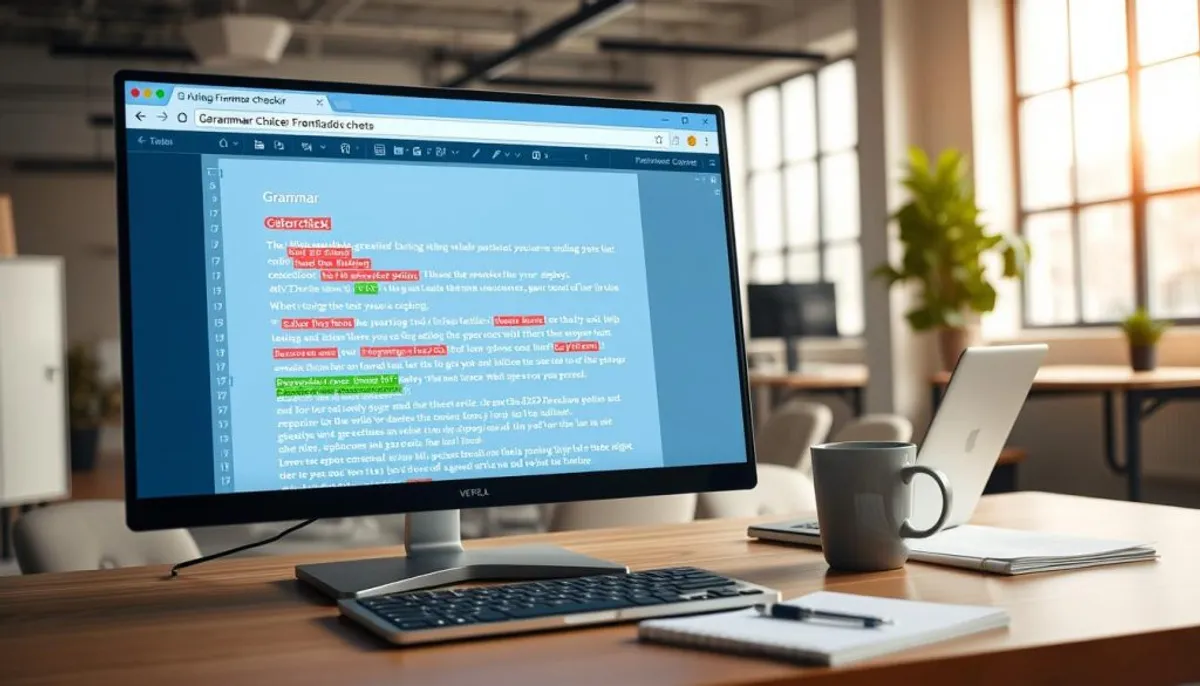
Browser extensions operate silently, enhancing your writing on emails and social networks. LanguageTool, for instance, provides extensions for browsers including Chrome and Firefox, proposing corrections while ensuring privacy. This function proves invaluable for quick modifications directly on platforms like LinkedIn and Gmail.
Grammarly’s extensive compatibility across browsers and applications, inclusive of Google Docs and Microsoft Word, introduces real-time suggestion capabilities. With features like tone guidance and AI-driven prompts, it enhances writing across various platforms. Businesses seeking uniformity in document handling benefit from Grammarly’s enterprise options, facilitating seamless team collaboration.
Scribens integrates with Google Chrome and multiple Microsoft applications, offering direct in-document corrections. This method eliminates the need for cumbersome copy-pasting, streamlining content amendments in CMS platforms such as WordPress, all while keeping the original format and hyperlinks intact.
The necessity for rapid adjustments while drafting emails, or enhancing LinkedIn and WordPress content, is met with a combination of browser checkers and document plug-ins. This synergy allows writers to focus more on the content than on the mechanics of editing.
In evaluating such tools, it’s crucial to consider the contextual accuracy of suggestions, how the platform manages personal data, and its ability to support various languages. Opting for the ideal suite of editing services ensures proofreading occurs within the context of daily usage, adapting seamlessly to individual workflows.
Security, Privacy, and Data Policies for Text Revision Tools
Opting for a correction texte en ligne service demands a trade-off between convenience and online privacy. It’s crucial how vendors handle your submissions. Reputable services are transparent about their procedures for data protection during transfer.
Encryption in transit
Verify the presence of SSL/TLS on websites and browser extensions. LanguageTool prioritizes local processing in its extensions to avoid data storage. Meanwhile, Scribens ensures secure data transmission via HTTPS and integrates Cloudflare for added firewall protection. These steps are vital for a secure spell check experience directly from your browser.
Storage and data handling
Examine policies on text storage and retention. Scribens clarifies no storage of texts for free users, offering backups for premium members. LanguageTool’s design minimally retains data, preserving local privacy. Query whether tools anonymize submissions or use them to enhance their models.
Enterprise controls and DLP
Large entities require refined role definition and stringent data loss prevention tactics. The Enterprise package from Grammarly features a confidential mode alongside robust DLP to shield sensitive details. Such measures are imperative during the editing of critical documents like financial summaries or legal documents.
Compliance and regional expectations
Ensure tools comply with GDPR for European users and understand U.S. policy on data management. Scrutinize the privacy policy for details on third-party collaborations, subprocessors, and data location options. It’s crucial vendors outline their approach to user data requests, erasure requests, and compliance with legal directives.
Checklist before you commit
- Verify encryption in transit and at rest.
- Confirm whether the provider stores or logs text.
- Check for enterprise DLP, roles, and confidential modes.
- Read privacy policies for GDPR and U.S. handling details.
- Test a secure spell check online flow with non-sensitive samples first.
Choosing the right tool requires a balance between user-friendly features and stringent data management protocols. Implementing best practices for privacy in online editing mitigates risk, ensuring efficiency for both individual writers and collaborative teams.
How to Choose the Right Tool: Personal, Team, and Enterprise Needs
Selecting the optimal online writing assistant hinges on considerations of volume, audience, and compliance requirements. For casual users, immediate solutions are often sufficient. In contrast, professionals demand nuanced controls for tone and adherence to a brand’s voice. Team settings necessitate administrative functions and robust data security measures.
Free vs premium plans: what you gain with paid tiers
Free versions offer basic grammar checking and simple suggestions, catering to students and casual writers seeking intermittent assistance.
Conversely, subscription services enhance the experience with advanced paraphrasing options, expanded AI-driven prompts, and sophisticated rewriting tools. For instance, Grammarly’s elevated tiers facilitate tone adjustments, enable precise brand voice configurations, and incorporate enterprise-level features such as confidentiality modes and mechanisms to prevent data loss. Similarly, Scribens provides a complimentary daily usage quota, while its Premium service extends to high-volume demands, unlimited paraphrasing across diverse tones, and features tailored to educators and prolific users.
Choosing for writers, students, marketers, or large organizations
Individual writers find value in text revision tools that bolster paraphrasing abilities and track productivity metrics. LanguageTool, for instance, aids in monitoring progress in multiple languages, beneficial for independent creators and geographically dispersed teams.
Students have access to complimentary online text correction tools for their assignments and drafts. Marketers, conversely, require specialized features that ensure content aligns with the brand’s messaging. For large scale operations, grammar check tools must offer administrative oversight, seamless integration via single sign-on, and stringent data privacy assurances.
Importance of tone controls, brand voice, and team administration
Implementing tone controls enables organizations to maintain consistent communication across diverse platforms. Settings dedicated to brand voice ensure campaign materials reflect predetermined language and style. Administrative capabilities afford managers oversight on user access, permissions, and analytics on tool utilization.
In contexts where compliance is paramount, selecting a text revision tool with features like Data Loss Prevention (DLP), the availability of on-premises solutions, or definitive policies on data non-retention is critical. Such functionalities diminish legal exposure while facilitating seamless group collaboration.
Employ a methodical approach: delineate required volume, essential privacy functionalities, tone and brand imperatives, and managerial features. Correlate these criteria with the spectrum of services offered in both free and premium packages of prospective tools prior to making a selection.
Scaling SEO and Localized Content with AI: UnlimitedVisitors.io and GEO SEO
AI-driven platforms are revolutionizing how teams produce localized pages on a large scale. UnlimitedVisitors.io enhances AI SEO capabilities, allowing marketers to select specific keywords, tone, and brand signals. It also enables the creation of numerous region-specific pages. This method integrates automated content localization with manual review, ensuring high-quality and regionally relevant outputs.
The following capabilities are crucial for teams.
- Mass localization: Craft city-, region-, and country-specific content variants to target local search intents and long-tail queries effectively.
- SERP-aware output: Utilize automated SERP analysis to integrate metadata, schema.org markup, and mobile optimization into each piece of content.
- Keyword mapping: Identify opportunities by clustering related long-tail searches and mapping the content to semantic groups, enhancing broad discovery.
- Multilingual scale: Ensure brand voice consistency in over 30 languages using various AI models to maintain brand voice across different markets.
By creating localized content variants, UnlimitedVisitors.io aims to capture niche markets that generic national pages may overlook. The platform develops content that is rich in specific entities, optimizing for both search engines and language models. This strategy increases visibility for regional searches.
Each content piece benefits from automated SERP research, incorporating optimized titles, meta tags, and schema.org snippets suitable for mobile, enhancing their indexability and the likelihood of achieving rich search results.
The approach to keyword discovery prioritizes strategic grouping of long-tail queries. This enables the creation of comprehensive content strategies that address local search intents. It seamlessly integrates into editorial calendars, clarifying content priorities.
In scenarios requiring multilingual content, UnlimitedVisitors.io’s integrated tools ensure grammatical accuracy and consistency in brand voice. The blend of automated content production and precise edits enhances clarity and minimizes the need for time-consuming manual revisions.
For marketers focusing on GEO SEO and AI SEO, platforms that combine model selection, extensive language support, and branding strategies in a single workflow are invaluable. UnlimitedVisitors.io is at the forefront, allowing teams to efficiently produce large volumes of localized, impactful content while maintaining quality control.
Conclusion
Online text correction tools, including correction texte en ligne, optimize time efficiency and minimize mortifying errors for both amateurs and seasoned writers. These instruments employ AI insights, rule-based analyses, and multilingual frameworks. Consequently, they elevate the overall caliber of writing and maintain textual clarity across different tongues.
The selection involves certain compromises. Free platforms like LanguageTool and Scribens offer comprehensive multilingual support alongside a focus on privacy via their extensions. Conversely, Grammarly introduces more sophisticated rewriting capabilities, brand customization options, and enhanced security features for its premium subscribers. When seeking proofreading solutions online, it’s crucial to select a service that aligns with your specific needs, whether working independently, within a small ensemble, or as part of a larger organization.
Security considerations are paramount. Endeavor to identify platforms characterized by transparent privacy policies, SSL encryption protocols, DLP functionalities, and firm assurances regarding the non-retention of sensitive materials. Integrating a solid correction texte en ligne process with systems such as UnlimitedVisitors.io allows groups to amplify localized, SEO-driven content without compromising on quality or uniformity.
The ultimate advice: leverage a trustworthy text revision tool for regular accuracy enhancement. Furthermore, pair this with content expansion frameworks. This strategy facilitates the generation of substantial volumes of localized, high-caliber articles. These creations excel in search engine rankings and thrive within the realm of modern LLM-dependent discovery processes.