
So you’re shopping for content and one writer charges $50 while another wants $2,000 for basically the same thing? You’re not crazy. The pricing landscape for online articles is wildly inconsistent, and there’s actually a good reason for that confusion.
Here’s the reality: web content writing rates can range from a penny per word to two dollars per word. In Quebec, beginners charge around $30-$44 CAD per hour, experienced professionals ask $58-$102 per hour, and specialized experts command up to $292 per hour. That’s not a typo—the range really is that massive.
The pricing varies so much because “writing for the internet” means completely different things. Some businesses just need basic text to fill pages. Others need strategic content that ranks on Google and actually converts visitors into customers.
Now AI platforms are reshaping the entire economics of content creation. They’re offering to produce dozens of localized articles for what one premium writer charges for a single piece. This guide cuts through the confusion to help you figure out what you actually need, what you should expect to pay, and how to make smart content investment decisions in this changing landscape.
Understanding the Web Writing Pricing Landscape
If you’ve ever shopped around for web writing services, you’ve probably noticed that quotes can vary wildly—sometimes by thousands of dollars. One writer charges $50 for a 1,000-word blog post while another wants $500 for the same length. A third option offers unlimited content for a flat monthly fee. What gives?
The answer isn’t simple because web writing isn’t a commodity. It’s a service that spans an enormous quality spectrum, from hastily assembled content farms to strategic thought leadership that drives business results.
Why Web Writing Rates Vary So Dramatically
The range in best content writing prices exists because “web content” covers vastly different types of work. A basic product description requires minimal research and takes maybe 20 minutes to write. A comprehensive guide analyzing industry trends might demand days of research, expert interviews, and careful optimization.
Writers charging bottom-tier rates typically produce generic content with minimal research. They’re not thinking about search intent, user engagement, or whether the piece actually serves your business goals. They’re hitting word counts and moving on.
Meanwhile, higher-tier writers bring specialized knowledge to the table. They understand how to structure content for both human readers and search algorithms. They know the difference between informational, commercial, and transactional intent. They can weave in semantic keywords naturally while maintaining readability.
Here’s what separates different pricing tiers:
- Research depth: Surface-level rehashing versus original insights backed by data
- SEO expertise: Basic keyword placement versus comprehensive semantic optimization
- Technical skills: Plain text versus schema markup, proper heading hierarchy, and metadata integration
- Strategic thinking: Content for content’s sake versus pieces designed to move prospects through your funnel
- Quality control: First-draft publishing versus editing, fact-checking, and revision cycles
The 2025 landscape has raised the bar even higher. Google’s Helpful Content Update and the emergence of Search Generative Experience (SGE) mean that mediocre content simply won’t cut it anymore. Your content needs to demonstrate genuine expertise, authoritativeness, and trustworthiness—the famous EEAT criteria that now dominate ranking factors.
This shift has increased demand for writers who understand semantic optimization tools like SurferSEO, Clearscope, and NeuronWriter. Writers who can structure content for conversational search and voice queries command premium rates. Those who can integrate multimodal elements—combining text with visual strategy and video concepts—can charge 15-30% more than text-only specialists.
The Shift from Traditional to AI-Powered Content Creation
The economics of content creation are undergoing a massive transformation. Traditional freelance writers, even highly skilled ones, face hard limits on output. A talented writer might produce two to four polished articles per week. That’s their ceiling.
AI-powered content platforms have shattered that limitation. These systems can generate hundreds of localized content variants in the time it takes a human to write a single piece. We’re not talking about replacing quality with quantity—we’re talking about achieving scale that was literally impossible with human-only workflows.
This creates interesting dynamics in SEO content pricing. Traditional freelancers maintain their value for certain content types—original research, expert commentary, brand storytelling that requires genuine human perspective. But for high-volume needs like location-specific landing pages, product variations, or long-tail keyword coverage, AI platforms offer compelling economics.
The cost comparison is striking:
| Approach | Weekly Output | Typical Monthly Cost | Cost Per Article |
|---|---|---|---|
| Entry-Level Freelancer | 8-12 articles | $400-$1,200 | $50-$100 |
| Professional Freelancer | 8-16 articles | $1,600-$4,000 | $200-$250 |
| Premium Specialist | 4-8 articles | $2,000-$4,000 | $500-$1,000 |
| AI Content Platform | 100+ articles | $200-$1,000 | $2-$10 |
The question isn’t whether AI will replace human writers entirely—it won’t. The question is which content types benefit most from human creativity versus AI scalability. Smart content strategies increasingly blend both approaches.
What Today’s Content Buyers Really Need
Understanding current buyer needs helps explain why SEO content pricing has become so varied. Buyers in 2025 aren’t just looking for “articles.” They need content that performs specific strategic functions.
First, content must work for both traditional search engines and AI-powered discovery. That means structuring information so it can be extracted and summarized by large language models. It means optimizing for featured snippets, Google Perspectives, and conversational queries.
Second, content needs to demonstrate genuine expertise. Google’s algorithms have become remarkably good at identifying thin, regurgitated content. Buyers need writers who bring real knowledge and fresh perspectives, not keyword stuffers who rephrase what’s already ranking.
Third, modern content must work across devices and formats. Mobile-first indexing means your content needs to perform beautifully on small screens. Voice search optimization requires natural language patterns and question-answer structures. Schema markup needs to help search engines understand your content’s context and relationships.
Fourth, buyers increasingly need volume and localization. If you’re a service business operating in 50 cities, you need unique content for each location. If you’re an e-commerce platform with thousands of products, you need optimized descriptions at scale. Traditional freelance models simply can’t deliver this volume at reasonable costs.
Finally, buyers need measurable results. It’s not enough to publish content—you need pieces that actually drive organic traffic, engage visitors, and convert prospects. This requires understanding content analytics, user behavior signals, and conversion optimization principles.
The bottom line? Finding the best content writing prices means matching your specific needs to the right service model. Boutique human-crafted content has its place. Budget-friendly basic execution serves certain purposes. AI-powered platforms excel at scalable, localized content generation.
Understanding these distinctions—and being honest about what you actually need—is the foundation of smart content investment. The cheapest option rarely delivers real value, but the most expensive isn’t always necessary either. The right choice depends entirely on your volume requirements, quality standards, and strategic objectives.
Key Factors That Influence Tarif Rédaction Web
The difference between a $50 article and a $500 article comes down to several concrete factors that directly impact quality and results. Understanding these variables helps you evaluate professional content creation fees with confidence. Let’s break down exactly what you’re paying for when rates climb from budget to premium tiers.
Each pricing factor represents real value that affects your content’s performance. Some variables matter more depending on your specific goals. Knowing which elements justify higher costs lets you invest strategically rather than overpaying for features you don’t need.
Writer Experience and Subject Matter Expertise
A writer’s background makes an enormous difference in both quality and pricing. Beginners in markets like Quebec charge around $0.07-$0.12 CAD per word, while experienced professionals command $0.18-$0.36 CAD per word. That gap reflects years of refinement in craft, industry knowledge, and proven results.
Specialized expertise pushes rates even higher. Writers with deep knowledge in medical, legal, or technical fields can charge up to $2.92 CAD per word because they bring something rare to the table. They understand complex concepts, speak your audience’s language fluently, and know which details matter most in your industry.
This expertise directly impacts website copywriting rates across different service tiers. A generalist might write competently about marketing basics. A B2B SaaS specialist understands buyer journeys, technical integration concerns, and the specific pain points that convert enterprise customers—knowledge that transforms ordinary content into revenue-generating assets.
Content Complexity and Research Depth
Writing a simple listicle versus creating a comprehensive guide requires completely different skill sets and time investments. Low-cost writers often produce 1,000+ words per hour by working from templates and surface-level research. Premium writers spend significantly more time on each piece.
The research phase alone can consume hours before writing begins. Professional writers invest time in:
- Client briefing sessions to understand goals and brand voice
- Expert interviews to gather unique insights and quotes
- Primary research including surveys or data analysis
- Competitive analysis to identify content gaps and opportunities
- Documentation review for technical or specialized topics
Complex topics require writers who can synthesize multiple sources, present technical concepts clearly, and structure information logically. That expertise costs more because it’s harder to find and takes longer to execute well.
Language Requirements and Localization Scope
Creating content in multiple languages multiplies both complexity and cost dramatically. Professional localization goes far beyond simple translation—it requires adapting tone, cultural references, examples, and even offers to resonate with different markets. Traditional approaches make this prohibitively expensive for most businesses.
Manual localization typically costs $0.10-$0.25 per word on top of original content creation fees. For a 2,000-word article translated into ten languages, you’re looking at $2,000-$5,000 in translation costs alone. Regional variations within languages add even more complexity and expense.
This is where platforms like UnlimitedVisitors.io fundamentally change the economics. The platform generates content across 30+ languages with city, region, and country-specific variants that would cost a fortune to produce manually. You can create thousands of localized long-tail articles covering geographical variations without the traditional per-word multiplication of costs.
The localization factor explains why some content investments seem expensive until you calculate the alternative. Creating genuinely localized content at scale has historically been accessible only to enterprises with massive budgets. AI-powered platforms have democratized this capability.
SEO Optimization and Technical Specifications
Modern SEO-optimized content requires far more than keyword placement. Professional writers invest in sophisticated tools and ongoing education to deliver technical optimization that actually moves search rankings. These overhead costs directly influence website copywriting rates across the industry.
The tool stack alone represents significant monthly expenses:
- SEMrush: $129.95/month for keyword research and competitor analysis
- Ahrefs: $99-$999/month for backlink analysis and content research
- 1.fr: €60/month for semantic optimization and entity analysis
- Antidote: €59/year for advanced grammar and style checking
Professional writers typically spend $100-$200 per month on these tools. That overhead gets factored into their rates because it’s essential for delivering competitive SEO performance.
But tools are just the beginning. Proper optimization includes semantic research, entity optimization, schema markup implementation, heading hierarchy, internal linking strategy, mobile formatting, and comprehensive alt text strategy. Each element requires specialized knowledge and adds time to the production process.
Writers who deliver this level of technical sophistication command premium rates because they’re not just creating content—they’re engineering assets that perform in search engines. The difference in results justifies the higher investment for businesses that depend on organic visibility.
All these factors compound rather than simply add up. A specialized writer producing deeply researched, SEO-optimized content across multiple languages represents an entirely different value proposition than someone churning out basic blog posts. Professional content creation fees reflect this reality—and understanding these variables helps you identify where to invest for maximum impact.
Common Pricing Models for Web Content Creation
The way you structure payment for content creation matters almost as much as the content itself. Different pricing approaches influence not just your budget, but also the quality and strategic value of what you receive. Understanding these models helps you make smarter decisions about affordable web copy pricing that aligns with your specific needs.
Most content buyers encounter four main pricing structures. Each has distinct advantages and drawbacks that affect both the writer’s workflow and your final results.
Per-Word Pricing Structure Explained
Per-word pricing seems straightforward on the surface. You need 2,000 words, the writer charges $0.15 per word, and you pay $300. Simple math, predictable budgets.
But this model has serious limitations. It completely ignores the invisible work that makes content valuable—research time, strategic planning, SEO optimization, and revision rounds. All the back-and-forth communication that ensures content hits your goals? That’s not counted either.
French market data shows per-word rates ranging from €0.01 to €2.00 per word, depending on expertise and subject complexity. The journalism industry also uses per-feuillet pricing (1,500 characters or roughly 250 words) at €40-70 per unit.
The fundamental problem with per-word pricing is the incentive structure. Writers get paid more for writing more, which can encourage word padding instead of concise, powerful messaging. Quality takes a backseat to quantity when your paycheck depends on hitting word counts.
Project-Based Flat Rate Arrangements
Flat rate pricing fixes many per-word problems by focusing on deliverables instead of word counts. You agree on a complete project—”$800 for a comprehensive buyer’s guide”—and the writer focuses on results.
This approach works beautifully for well-defined projects with clear scope. French market research indicates per-page pricing ranges from €60-200 for original creation and €50-100 for rewriting existing content. Blog articles of 400-500 words typically cost €120-400 as complete packages.
The challenge comes when scope creeps. If revisions multiply or the project expands beyond original expectations, flat rates can create tension. Smart buyers and writers address this with clear scope documents and revision policies upfront.
Hourly Billing for Content Services
Hourly rates account for all the hidden work that per-word pricing ignores. Research, strategy sessions, client calls, and revisions all get compensated fairly.
Quebec market data shows hourly rates ranging from $29.19 to $291.94 CAD depending on writer experience and specialization. This flexibility makes hourly billing attractive for complex projects where time investment is hard to predict.
The downside? Clients often dislike the unpredictability. Final costs can surprise you, and there’s an odd incentive problem—faster, more experienced writers actually earn less per project than slower ones. This online article writing cost model works best when you have ongoing needs and trust your writer.
In France, the daily rate model (TJM – Taux Journalier Moyen) is particularly popular. According to Malt platform data, TJM represents the most common pricing structure for French freelancers. Average daily rates sit at €375, with a range from €120 to €810+ depending on expertise and specialization.
Subscription and Platform-Based Models
Here’s where things get interesting for businesses needing volume. Instead of hiring individual writers per project, subscription models provide access to content generation for a flat monthly fee.
AI-powered platforms like UnlimitedVisitors.io represent this shift. You’re not paying per word, per hour, or even per article. You’re paying for technology access that generates high volumes of localized content across multiple languages.
This model changes the economics dramatically. For less than hiring one experienced freelancer for a week, platforms can produce hundreds of geo-targeted articles optimized for different markets and search intent.
The subscription approach makes sense when you need scale. If your content strategy involves creating variations for different cities, regions, or countries—or if you’re targeting long-tail keywords across multiple languages—platform pricing often delivers better affordable web copy pricing than traditional per-project models.
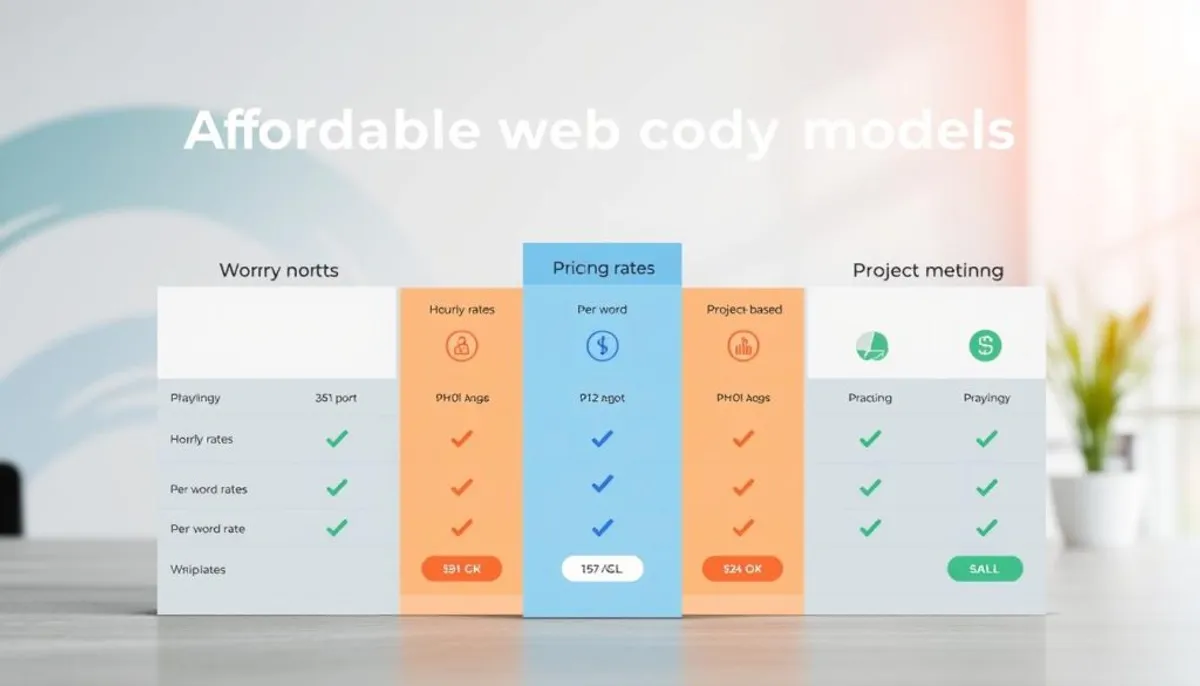
| Pricing Model | Best For | Main Advantage | Key Limitation |
|---|---|---|---|
| Per-Word | Small, defined projects | Predictable budgeting | Ignores research and strategy time |
| Flat Rate / Project-Based | Clear scope deliverables | Focus on results, not word count | Scope creep creates conflicts |
| Hourly / Daily Rate (TJM) | Complex or ongoing work | Compensates all invisible labor | Unpredictable final costs |
| Subscription / Platform | High-volume, multi-market needs | Massive scalability at fixed cost | Less individual customization |
Each pricing structure serves different business situations. Small projects with crystal-clear requirements? Flat rates work great. Ongoing content needs with variable complexity? Consider hourly or daily rates. Need to scale content across geographic markets, languages, and hundreds of keyword variations? That’s when platform subscriptions start making serious financial sense.
The key is matching the pricing model to your actual content requirements rather than just choosing the lowest online article writing cost. The cheapest option per word might cost you more in the long run if it delivers shallow content that doesn’t convert or rank.
Traditional Freelance Rates vs AI Content Platforms
Understanding the real cost structure behind traditional freelance writing reveals why AI platforms are disrupting the industry. The economics of content creation involve much more than just paying someone to type words on a screen. There’s a complex web of business expenses, time limitations, and scalability challenges that make traditional models increasingly difficult to sustain for volume-focused content needs.
Let’s break down the actual numbers and see how AI-powered platforms are fundamentally changing the game for businesses that need consistent, localized content at scale.
The Real Economics Behind Manual Content Creation
When you hire a freelance writer, especially in markets like France or Quebec, you’re not just paying for their time at the keyboard. You’re funding an entire business infrastructure that includes mandatory expenses most content buyers never consider.
A professional French freelance writer faces substantial overhead costs that drive up what they must charge. These aren’t optional luxuries—they’re required business expenses.
Here’s what goes into the actual french writing services cost structure:
- URSSAF social charges: 22% of all revenue goes to mandatory social contributions
- Income tax: Progressive rates that can reach 30-45% depending on earnings
- Business taxes (CFE): Annual territorial economic contribution
- Professional insurance: Liability coverage required for business operations
- Health insurance: Private coverage to supplement public systems
- Paid leave provisions: Self-funded vacation and sick time reserves
- Ongoing training costs: SEO tools, writing courses, industry certifications
- Software subscriptions: €100-200/month for SEO tools, grammar checkers, project management
- Standard living expenses: Rent, utilities, food, transportation
To match the French minimum wage of €10.85/hour gross, a freelancer needs to charge approximately €40-50 per hour after covering all these costs. That’s the break-even point just to earn what an entry-level employee makes.
Established professional writers charge premium rates. For quality SEO content, expect to pay €0.15-0.30 per word from experienced French writers. Premium specialists command €0.10-2.00 per word depending on technical complexity and expertise level.
A well-researched, SEO-optimized 1,500-word article takes 3-5 hours when you factor in research, outlining, writing, optimization, and client revisions. That translates to €120-250 per article minimum for quality work from professional writers.
Why Human-Only Writing Hits a Scalability Ceiling
Here’s the hard truth about traditional content creation: there’s a productivity ceiling that’s impossible to break through. Even the most efficient writer can only produce so much quality content in a given timeframe.
A productive freelance writer realistically creates 2-4 substantial, well-researched articles per week. That’s assuming they’re working full-time on content creation without juggling multiple clients or administrative tasks.
Let’s do the math on a common business scenario. You need 50 localized articles covering your service areas across multiple cities. At 3-4 articles per week, you’re looking at 12-15 weeks of production time and an investment of €6,000-12,500.
Need that same content in three languages for international markets? Triple the timeline and budget. Want monthly content updates? You’ll need to hire multiple writers or accept a very slow rollout.
The offshore alternative seems tempting. French writing services cost significantly less from writers in Madagascar, Morocco, or Tunisia—sometimes just €20-40 per article. But there’s usually a tradeoff in native fluency, cultural understanding, and SEO sophistication.
You often get what you pay for with budget offshore content. The savings come at the expense of quality that can impact your brand perception and search rankings.
How Platforms Like UnlimitedVisitors.io Transform Content Economics
AI content platforms operate on a completely different economic model that breaks through traditional scalability barriers. Instead of paying for human time, you’re leveraging technology that generates dozens or hundreds of articles in the time it takes a human to write one.
UnlimitedVisitors.io exemplifies this transformation. The platform can create city-specific, region-specific, and country-specific content variants at scale. Think “plumbing services in Austin,” “plumbing services in Dallas,” “plumbing services in Houston” across hundreds of locations automatically.
The platform handles keyword research, clustering, semantic optimization, schema markup, and formatting without additional human intervention. You’re generating more content in a day than a traditional freelancer could produce in months.
Here’s the economic comparison that matters:
| Factor | Traditional Freelance | AI Platform (UnlimitedVisitors.io) |
|---|---|---|
| Cost per article | €120-250 for quality SEO content | Fraction of traditional cost via subscription |
| Production capacity | 2-4 articles per week maximum | Hundreds of articles per day possible |
| Localization scalability | Requires separate writers or translation | 30+ languages with automated variants |
| Geographic coverage | Limited by writer availability and time | Unlimited city/region/country variations |
| SEO optimization | Depends on individual writer expertise | Built-in SERP research and entity optimization |
This doesn’t mean human writers are obsolete. They’re still unbeatable for brand storytelling, thought leadership pieces, and content requiring genuine creativity and original insights. Executive communications, case studies, and unique perspective pieces benefit from human expertise.
But for scalable, localized, SEO-optimized content across multiple markets? The economics of AI platforms are game-changing. You’re choosing between boutique handcrafted content at premium prices with limited scalability versus industrialized content production that covers massive keyword and geographic territory.
The transformation isn’t about replacing humans entirely. It’s about matching the right tool to the right content need and using your budget strategically. Use human writers for high-value, brand-defining content. Deploy AI platforms for the volume SEO work that drives organic discovery at scale.
UnlimitedVisitors.io: Revolutionizing Content Pricing and Scale
What happens when you stop thinking about content creation as artisan work and start treating it like software engineering? That’s exactly the shift platforms like UnlimitedVisitors.io are bringing to the table. Instead of negotiating rates with individual writers or agencies, you’re looking at a completely different economic model that changes how businesses approach SEO content pricing altogether.
This isn’t just another freelancer marketplace or content mill. UnlimitedVisitors.io is built specifically to scale AI SEO, GEO (geographic optimization), and LLMO (large language model optimization) content. The platform tackles content production as a technical challenge rather than a creative bottleneck.
Generating Large Volumes of Localized Long-Tail Articles
Traditional tarif rédaction web calculations break down pretty quickly when you need hundreds or thousands of articles. Think about a business that operates across multiple locations and wants to rank for long-tail keywords in each area.
UnlimitedVisitors.io lets you generate massive volumes of localized content that targets specific long-tail queries. Instead of paying $200-500 per article through traditional channels, you’re working with a subscription model that covers unlimited generation within your plan.
The platform automatically handles keyword opportunity discovery and clusters related long-tail queries together. This means you’re not just getting random articles—you’re building a comprehensive content ecosystem that covers every variation your potential customers might search for.
City, Region, and Country-Specific Content Variants
Here’s where the economics really shift from traditional tarif rédaction web models. Imagine you run a service business in 50 different cities. The old approach meant commissioning 50 custom articles, each requiring research about that specific location.
With UnlimitedVisitors.io, you can generate all 50 geographic variants with proper localization in a fraction of the time. Each piece includes city-specific details, regional considerations, and local context that makes the content genuinely useful rather than just template-filled.
The platform creates content that’s optimized for both traditional search engines and modern LLMs like ChatGPT, Claude, and Gemini. This dual optimization matters because discovery is changing—people aren’t just Googling anymore; they’re asking AI assistants for recommendations.
Every article includes the technical elements that professional writers typically charge premium rates for. You get proper metadata, schema.org markup, mobile-ready formatting, and strategic alt text—all automated into the generation process.
30 Plus Languages and Multiple AI Models
Multilingual content traditionally multiplies your costs dramatically. A $300 English article might cost $400-600 in French, Spanish, or German when you factor in specialized translators or native writers.
UnlimitedVisitors.io supports over 30 languages within the same pricing structure. You’re not paying extra per language—it’s all included in your subscription. This makes international expansion or multilingual SEO strategies financially viable for businesses that would otherwise find the costs prohibitive.
The platform leverages multiple AI models, giving you access to the latest language technology without needing to manage different tools or vendors. You can customize tone, length, and style while maintaining consistency across languages and locations.
Brand voice integration ensures your company’s unique style comes through in every piece. The AI naturally weaves in your brand details throughout the content rather than dropping them in awkwardly.
Built-In SERP Research and Keyword Clustering
Professional SEO content pricing usually includes separate charges for keyword research and competitive analysis. Writers might add $100-300 per project just for the research phase before they even start writing.
UnlimitedVisitors.io automates this entire process with built-in SERP research. The platform analyzes what’s currently ranking for your target keywords and structures content accordingly. It identifies gaps in existing content and opportunities for long-tail coverage.
Keyword clustering groups related search queries together, ensuring your content addresses multiple variations without awkward keyword stuffing. This creates entity-rich content optimized for semantic search—exactly what modern search engines reward.
You can specify target keywords, select your target country, and customize content parameters. The system handles the technical SEO heavy lifting automatically, producing structured content that includes all the elements search engines and LLMs look for.
For businesses needing to cover extensive geographic territories, multiple languages, or hundreds of long-tail keyword variations, this approach makes traditional freelance pricing models look almost quaint. Instead of calculating costs per article or per word, you’re looking at flat monthly or annual fees for unlimited generation capacity.
The platform essentially functions as a full GEO plus AI SEO engine designed to expand long-tail reach and increase visibility across both Google and modern LLM-powered discovery channels. That’s a fundamentally different value proposition than hiring writers at standard tarif rédaction web rates.
Actual Rate Ranges Across Different Service Types
Pricing transparency matters, so here’s the breakdown of what web content writing rates look like across every tier—from budget writers to premium experts and AI platforms. Understanding these concrete numbers helps you budget smarter and avoid either overpaying or settling for work that won’t deliver results.
The content market operates across four distinct pricing tiers, each with its own value proposition and trade-offs. What you pay directly correlates with writer experience, subject expertise, and the delivery model you choose.
Budget-Friendly Entry-Level Writer Rates
Entry-level writers typically charge $0.07-0.12 per word, which translates to roughly $50-150 for a 500-word blog post. If you’re working with hourly billing, expect rates around $29-44 per hour.
This tier includes beginners building their portfolios, students looking for experience, and offshore writers from countries with lower living costs. Platforms like Fiverr and Upwork feature plenty of options in the €20-40 range for basic articles.
The catch? Quality varies dramatically. You might get serviceable content that fills space, but don’t expect sophisticated SEO strategy, deep research, or the cultural nuance that native writers bring. Grammar issues and awkward phrasing are common at this level.
These rates work when you need basic content volume and aren’t focused on ranking, conversion, or establishing brand authority.
Mid-Range Professional Content Pricing
Professional writers with proven track records charge $0.18-0.36 per word, putting most blog posts in the $200-500 range depending on length and complexity. Hourly rates typically run $58-102, with daily rates averaging around $375-450.
This is where web content writing rates hit the sweet spot for most businesses. You’re getting writers who understand SEO fundamentals, use proper keyword strategy, structure content effectively, and deliver clean, engaging copy that actually serves your marketing goals.
Mid-range professionals typically offer:
- Research-backed content with credible sources
- SEO optimization including meta descriptions and internal linking
- Clean writing that requires minimal editing
- Understanding of your target audience and brand voice
- Reliable delivery schedules and professional communication
For companies with reasonable content budgets who need consistent, professional work that performs, this tier delivers the best balance of quality and cost.
Premium Specialized Writer Costs
Top-tier specialized writers command $0.50-2.00+ per word, with rates sometimes reaching $2.92 per word for extremely specialized content. Hourly rates can hit $150-292, and comprehensive articles often cost $800-2,000 or more.
What justifies these premium rates? Deep subject matter expertise in fields like medicine, law, finance, or advanced technology. These writers bring credentials, industry experience, and insights that generic writers simply can’t match.
Premium writers don’t just execute—they strategize. Their content establishes thought leadership, drives significant business results, and often earns natural backlinks because of its authoritative value. You’re paying for their expertise and reputation, not just their time.
Daily rates for premium specialists typically range from €375-810, with full-service agencies charging €80-150 per hour for comprehensive content strategies.
AI Platform Subscription Economics
AI content platforms operate on a completely different pricing model. Instead of per-word or per-project fees, you pay a flat monthly or annual subscription ranging from $100-1,000+ depending on the platform’s capabilities and your volume needs.
This subscription model represents the best content writing prices when you need serious scale. For that flat fee, you can generate dozens or hundreds of articles, making the per-article cost dramatically lower than traditional writing services.
Platforms like UnlimitedVisitors.io exemplify this approach—offering unlimited article generation across multiple languages and geographic variants for a fixed monthly cost. The economics shift entirely: instead of budgeting per piece, you’re investing in content infrastructure.
The trade-off is straightforward: you’re exchanging the human touch and original strategic thinking for volume, consistency, and speed. AI platforms excel at producing structured, SEO-optimized content at scale but lack the creative insights and nuanced expertise that premium human writers provide.
| Service Tier | Per-Word Rate | Typical Article Cost | Best Use Case |
|---|---|---|---|
| Entry-Level Writers | $0.07-0.12 | $50-150 | Basic content volume, non-critical pages |
| Professional Writers | $0.18-0.36 | $200-500 | Regular blog content, SEO-focused articles |
| Premium Specialists | $0.50-2.00+ | $800-2,000+ | Thought leadership, specialized expertise |
| AI Platforms | N/A (subscription) | $100-1,000/month (unlimited) | High-volume localized content, long-tail coverage |
Bottom line for budgeting: Plan on $50-150 per article for basic content needs, $200-500 for professional work that performs, $800+ for premium specialized content, or $100-1,000 monthly for AI platform subscriptions that generate high volumes. Your choice depends entirely on your content goals, quality requirements, and scale demands.
Quality Indicators Beyond Basic Pricing
The gap between cheap content and professional work comes down to technical quality factors that rarely show up in pricing discussions. When you’re evaluating what you should actually get for your money, word count tells you almost nothing. The real value sits in invisible technical layers that drive rankings, visibility, and actual business results.
Most buyers focus on surface-level metrics like readability and grammar. But modern content needs to work on multiple levels simultaneously—for human readers, traditional search engines, voice assistants, and AI discovery tools. These technical requirements are what separate content that performs from content that just exists on a page.
Understanding these quality indicators helps you evaluate professional content creation fees intelligently. You’ll know exactly what you should be getting and why certain services cost more than others. More importantly, you’ll recognize when you’re getting real value versus just paying for extra words.
Entity-Rich Content and Semantic Search Optimization
Modern SEO isn’t about cramming keywords into sentences anymore. Search engines now use semantic relationships to understand content depth and authority. They identify entities—specific people, places, organizations, and concepts—and evaluate how well your content connects these elements.
Entity-rich content properly references relevant concepts and establishes clear topical relationships. For example, an article about digital marketing should naturally mention Google Analytics, conversion rates, and specific platforms while showing how these elements connect. This semantic approach signals expertise far better than keyword repetition ever could.
Professional writers use specialized tools like SurferSEO, Clearscope, and NeuronWriter to optimize for semantic relevance. This level of optimization requires technical knowledge and adds significant time to the writing process. It’s one of the key factors that justify higher website copywriting rates—and it’s something platforms like UnlimitedVisitors.io build in automatically.
The difference shows up in rankings. Content optimized for semantic search captures broader query variations and ranks for related terms you never explicitly targeted. That’s the kind of multiplicative value that makes technical optimization worth paying for.
Schema.org Markup and Metadata Integration
Here’s something most basic writers never touch: structured data markup. Schema.org markup tells search engines exactly what your content represents—whether it’s an article, product review, FAQ, or local business page. This invisible code layer enables rich snippets, featured answers, and enhanced SERP visibility.
Quality content services include comprehensive technical elements that casual readers never see:
- Proper title tags optimized for click-through rates and keyword relevance
- Meta descriptions that compel clicks while incorporating semantic keywords
- Header hierarchy (H1, H2, H3) that creates logical content structure
- Schema markup appropriate to content type and business goals
- Open Graph tags for social media sharing optimization
When you’re comparing professional content creation fees, ask whether these technical elements are included. They’re not optional extras—they’re essential components that determine whether your content can actually rank and convert. Most freelancers charge separately for technical SEO work, but comprehensive platforms include it as standard.
Mobile-Ready Formatting and Alt Strategy
With mobile-first indexing, Google primarily evaluates your content based on how it performs on small screens. That means proper formatting isn’t just about aesthetics—it directly impacts rankings. Professional content includes mobile-optimized formatting from the start.
This covers readable font sizing, proper spacing between elements, optimized image dimensions, and logical content breaks that work on mobile devices. Content that’s difficult to read on smartphones gets penalized in rankings, regardless of how well-written it might be.
Alt text strategy deserves special attention. Most writers treat alt text as an afterthought—a quick image description to meet accessibility requirements. But strategic alt text serves multiple purposes simultaneously: accessibility compliance, semantic keyword optimization, and image search visibility.
Quality alt text describes images accurately while incorporating relevant keywords naturally. It provides context that helps search engines understand how images relate to surrounding content. This dual-purpose approach is part of what you’re paying for with higher website copywriting rates—attention to details that multiply content value.
LLM Citation Optimization for Modern Discovery
Here’s the cutting-edge factor most content creators aren’t even thinking about yet: optimization for AI assistant citation. As ChatGPT, Claude, Gemini, and other AI tools become primary discovery mechanisms, content needs to be structured so LLMs will reference and cite it.
This represents a fundamental shift in how content gets discovered. Traditional SEO focused on ranking in search results. Now content also needs to be citable by AI assistants answering conversational queries. The technical requirements differ significantly from traditional search optimization.
LLM-friendly content includes clear factual statements, proper attribution for claims, structured data that AI can parse easily, and authoritative presentation. It means writing in ways that make information easy to extract and verify—not just easy to read.
UnlimitedVisitors.io specifically optimizes content for both traditional search engines and LLM discovery. The platform recognizes that future visibility depends on hybrid optimization—content that works for Google’s algorithms and AI assistant reference patterns. This forward-thinking approach is exactly what justifies premium pricing in today’s market.
| Quality Factor | Basic Content | Professional Content | AI Platform Standard |
|---|---|---|---|
| Semantic Optimization | Keyword repetition only | Entity relationships mapped | Automatic semantic analysis |
| Technical Markup | None or minimal | Full schema implementation | Comprehensive structured data |
| Mobile Formatting | Desktop-focused layout | Mobile-first responsive design | Optimized for all devices |
| LLM Optimization | Not considered | Available as add-on | Built into every article |
The bottom line: if you’re paying professional rates, you should be getting all these technical elements automatically. These invisible quality factors drive actual rankings and visibility—they’re what justify the price difference between cheap content and work that delivers results.
The best part about modern AI platforms? While individual freelancers charge extra for technical optimization, comprehensive services often include these elements as standard features. You get cutting-edge quality indicators without negotiating separate fees for each technical component.
Calculating Real ROI on Your Content Investment
The real question isn’t about finding the cheapest content, but identifying which content investment delivers the strongest ROI. Stop thinking about content as an expense and start viewing it as an investment with measurable returns. The businesses winning online today aren’t asking “what’s the cheapest option?” They’re asking “what content strategy will generate the best returns?”
Understanding content ROI transforms how you evaluate pricing. A $500 article that generates 500 qualified visitors monthly for two years delivers 12,000 total visitors. That works out to roughly $0.04 per visitor—far cheaper than paid advertising and significantly more sustainable.
Smart content investment requires tracking multiple performance indicators. You need to measure both immediate traffic gains and long-term value accumulation.
Capturing Traffic Through Strategic Keyword Targeting
Long-tail keyword coverage delivers some of the most valuable organic visibility you can achieve. Sure, ranking for broad terms like “web design” sounds impressive, but the competition makes it nearly impossible and expensive.
Here’s where smart strategy pays off. Targeting “web design for dental practices in Austin” alongside fifty similar variations becomes both achievable and profitable. These specific searches indicate clear intent—people are ready to take action.
Research shows the top three Google results capture about 60% of all clicks. This makes strong rankings extremely valuable. Long-tail keywords typically face lower competition while attracting visitors with higher conversion intent.
Geographic content amplifies this advantage. When you rank for location-specific searches across multiple cities, you’re capturing local traffic that competitors often miss. This approach transforms affordable web copy pricing into substantial traffic generation.
Tracking Performance Across Multiple Discovery Channels
Traditional analytics focus on Google rankings, organic traffic, and conversion rates. But the discovery landscape is shifting rapidly. AI assistants like ChatGPT and Gemini are becoming primary research tools.
When someone asks an AI assistant “what’s the best CRM for small businesses?” and your content gets cited in the response, that’s valuable visibility you need to track. Forward-thinking businesses now measure LLM citation frequency alongside traditional SEO metrics.
Modern content performance requires monitoring multiple channels:
- Google rankings and organic search traffic
- Featured snippet capture rates
- AI assistant citations and references
- Local pack appearances for geographic content
- Conversion rates and revenue attribution
Content marketing provides long-term value compared to paid advertising. Quality articles continue generating traffic for months or years after publication. This compounds your investment over time.
Balancing Scale and Substance in Content Production
The volume versus quality debate isn’t actually an either-or choice. The question is: what balance serves your specific business goals? For thought leadership and brand authority, premium content makes sense. But capturing long-tail geographic traffic requires volume.
Consider the math. Publishing 100 geographic variants at premium SEO content pricing of $500 each costs $50,000. Most businesses simply can’t justify that investment. However, platform subscriptions offering affordable web copy pricing make this scale financially viable.
Smart businesses are building hybrid content strategies that optimize both dimensions. They invest in premium human-created content for core brand messaging while using AI-generated content for long-tail and geographic coverage.
This approach maximizes ROI across different content purposes. Your hero content establishes authority while your volume content captures massive long-tail territory.
Measuring Geographic and AI-Optimized Content Success
Measuring GEO and LLMO content performance requires tracking both traditional and emerging metrics. Start with organic traffic and keyword rankings—these remain fundamental. Add local pack appearances to measure geographic content effectiveness.
Featured snippet capture indicates strong content quality and relevance. LLM citations and references show visibility in AI-powered discovery. But ultimately, conversions and revenue determine real success.
| Metric Type | What It Measures | Why It Matters |
|---|---|---|
| Organic Rankings | Search position for target keywords | Determines visibility and traffic potential |
| LLM Citations | AI assistant content references | Captures emerging discovery channel value |
| Local Pack Presence | Geographic search visibility | Drives location-specific conversions |
| Conversion Rate | Visitor-to-lead transformation | Directly connects to revenue impact |
The content that actually drives business results deserves investment, regardless of production cost. A $50 article generating significant leads delivers better ROI than a $500 article with minimal impact.
Platforms like UnlimitedVisitors.io excel at the volume and scale side of this equation. They let you capture massive long-tail territory at minimal cost per article. This frees up your SEO content pricing budget for premium hero content pieces that establish authority and drive brand recognition.
The shift to measuring content ROI rather than just content cost transforms your entire approach. You start making strategic decisions based on expected returns rather than minimizing expenses. This mindset shift separates businesses that struggle with content from those that use it to dominate their markets.
Matching Pricing Models to Your Business Needs
The smart way to approach web content writing rates starts with honestly assessing what your business truly needs. You can’t just pick a pricing model because it sounds good or because someone recommended it. Your choice should flow directly from your content goals, volume requirements, and strategic priorities.
Different businesses face wildly different content challenges. A local bakery needs completely different content than a nationwide insurance company or a SaaS startup expanding globally. Understanding these distinctions helps you avoid overpaying for services you don’t need or underspending on content that drives real growth.
Evaluating Your Content Volume Requirements
Start by getting brutally honest about how much content you actually need. Are you a local business that requires maybe 20 to 30 core articles? If so, investing in mid-range to premium human writers makes perfect sense.
These writers can capture your brand voice, inject personality, and create content that truly represents your expertise. The web content writing rates for this approach typically range from $150 to $500 per article, depending on complexity and writer experience.
But what if your situation looks completely different? Maybe you’re a service business operating in 50-plus cities. Or perhaps you’re an e-commerce site with hundreds of product categories. You might even be a company expanding into multiple countries simultaneously.
Now you’re looking at potentially hundreds or thousands of pieces of content. Traditional approaches quickly become financially impossible at scale. When you need 500 localized articles, the online article writing cost through conventional channels could hit $75,000 to $250,000.

Aligning Budget with Growth Objectives
Your content budget should directly reflect how central content is to your growth strategy. If you’re building an audience, establishing authority, and driving organic leads, content deserves significant investment.
Many successful content-driven businesses invest 20 to 40 percent of their marketing budget in content creation. That might sound high, but when content is your primary growth engine, it’s actually conservative.
If you’re bootstrapping or content plays a supplementary role to other channels, you might allocate less. The key principle is matching investment to strategic importance. Don’t follow generic advice about what you “should” spend.
Consider your actual growth objectives. Are you trying to dominate local search? Expand nationally? Enter international markets? Each goal requires different content volumes and sophistication levels, which directly impact what you should budget for web content writing rates.
When Full GEO Plus AI SEO Engines Make Financial Sense
Platform solutions like UnlimitedVisitors.io make the most financial sense in specific scenarios. Understanding when you’ve crossed into platform territory helps you avoid wasting money on the wrong approach.
You should seriously consider AI-powered platforms when you need content across multiple geographic locations. City, region, and country variants multiply your content needs exponentially. A single service offering in 100 cities means 100 localized pages minimum.
These platforms also shine when you’re targeting massive long-tail keyword coverage that would be cost-prohibitive with traditional writing. If your strategy involves capturing thousands of specific search queries, human-only creation simply doesn’t scale.
| Business Scenario | Content Need | Best Approach | Typical Investment |
|---|---|---|---|
| Local service business | 20-50 core articles | Mid-range human writers | $3,000-$15,000 one-time |
| Multi-location service company | 200-1,000 localized pages | AI platform with customization | $200-$800 monthly |
| E-commerce with large catalog | 500+ product/category pages | Hybrid: human + AI platform | $5,000-$10,000 + $300-$600 monthly |
| International expansion | Multi-language content sets | AI platform with 30+ languages | $400-$1,000 monthly |
Multilingual content requirements also push businesses toward platform solutions. If you need content in multiple languages, the online article writing cost through traditional translation and localization services becomes prohibitive. Platforms offering 30-plus languages change the economics completely.
Finally, if you want to capture both traditional search and LLM-powered discovery, you need content volume that’s simply impossible with human-only creation. Modern discoverability requires covering more topics, locations, and query variations than ever before.
The math becomes clear quickly. The online article writing cost for 100 localized articles through traditional channels might be $15,000 to $50,000. Through an AI platform subscription, you’re looking at a few hundred dollars per month.
Customization Options from Keywords to Brand Voice
Even when using AI platforms, you still need customization capabilities that go beyond generic content generation. Good platforms let you input your specific keywords, choose your target language and country, and set appropriate tone and length.
Brand-specific details and voice integration separate quality platforms from basic content mills. UnlimitedVisitors.io, for example, lets you add brand information that the AI naturally weaves throughout generated content. You’re not getting generic robot-speak—you’re getting on-brand, customized content at scale.
The best approach for most businesses is building a hybrid strategy. Invest in premium human-created content for your cornerstone pieces. These include key service pages, main blog topics, thought leadership content, and brand storytelling.
Then use AI platforms to scale around those core pieces. Generate geographic variants, cover long-tail topics, create supporting content, and expand into new markets or languages. This gives you both the quality and authenticity of human expertise where it matters most.
You also get the scale and efficiency of AI where volume is the priority. This balanced approach optimizes your spending on web content writing rates while maximizing your content’s business impact.
Match your content investment to your actual needs, not to what generic advice suggests. Your business is unique, and your content strategy should reflect that reality.
Conclusion
Understanding tarif rédaction web means recognizing that pricing alone tells you nothing about value. The cheapest option rarely delivers results, while the most expensive doesn’t guarantee success. Your content investment should align with specific business objectives and produce measurable returns.
The content landscape has changed dramatically. Traditional freelance writers remain essential for specialized work requiring deep expertise and brand understanding. Platforms like UnlimitedVisitors.io now make massive-scale content strategies achievable—covering multiple languages, geographic markets, and thousands of long-tail keywords that were previously cost-prohibitive.
Smart businesses build hybrid approaches. They invest premium rates in core brand content while leveraging AI-powered platforms for volume-based geographic and linguistic expansion. This combination delivers both quality and scale.
When evaluating the best content writing prices, think beyond the invoice amount. A $1,000 article generating $50,000 in revenue represents incredible ROI. A $20 piece that accomplishes nothing wastes both money and opportunity. Content marketing delivers long-term value that continues generating results months and years after creation.
Focus on what you need to accomplish: building authority, capturing search traffic, expanding markets, or establishing thought leadership. Match your investment to those goals rather than arbitrary budgets. You have more options than ever at every price point and scale requirement. Choose strategically, measure results consistently, and adjust based on actual performance data.