
Local visibility is crucial for small businesses in the United States. A Google Maps rank checker, also known as a local SEO rank tracker or Google Places rank checker, delineates how your Google Business Profile or place listing is perceived by potential customers across various neighborhoods, keywords, and devices.
Consider it a piece of map rank tracking software that transforms search results into actionable insights. By understanding your standing in the local pack, you enable an increase in calls and foot traffic, while also setting benchmarks against competitors.
The tools available span from complimentary services to comprehensive enterprise solutions. Localo presents a no-cost Local Rank Checker alongside profile protection, visibility monitoring, and review posting across over 26,815 Google Business Profiles. Local Falcon introduced multipoint geo-grid scans and heat maps to identify trends. Conversely, GMB Radar emphasizes cost-efficiency with bespoke geo-grid scans, credit-based pricing, and white-label reports.
This piece elucidates on the pivotal features, the distinctive characteristics of Local Falcon, GMB Radar, Localo, among others, and outlines the procedure for launching effective map rank tracking campaigns. Moreover, it explores how platforms like UnlimitedVisitors.io employ AI to augment GEO content and enhance map visibility.
Why local search visibility matters for U.S. businesses
Many customer journeys commence with local search when seeking nearby services or stores. Achieving prominence in local search results transforms these searches into tangible interactions such as calls, direction requests, and site visits. Particularly for entities like restaurants, plumbing outfits, and retail establishments, visibility on digital maps frequently results in immediate engagement.
Local visibility drives foot traffic and calls
For the sake of convenience, people often select businesses that appear on map results. An elevated position within the local search rankings secures a significant volume of digital engagements. Even minor advancements in map positioning can escalate foot traffic for retail locations or augment appointments for service-oriented businesses.
How Google Maps impacts conversions and discovery
Google Maps showcases essential details like operating hours, reviews, and navigational information instantaneously. This immediacy diminishes barriers to user conversion. Strategically, a business ranking higher in Maps typically garners more directions requests than if positioned lower in organic search results.
Evidence from tools and case studies
Digital tools quantify the benefits of optimization. Users of Localo observe prompt enhancements in visibility following recommended adjustments, with rankings climbing swiftly into the top echelons. Furthermore, Local Falcon’s geo-grid technology is celebrated for its ability to reveal localized weaknesses, benefiting both singular and multi-location entities.
Feedback on GMB Radar emphasizes its precision in location tracking and its cost-effectiveness, making it an invaluable resource for agency and small business applications. Employing a local SEO rank tracker or specialized Google Maps ranking tools enables strategists to refine their focus, be it through content augmentation, citation building, or GBP optimization.
| Tool | Strength | Typical outcome |
|---|---|---|
| Localo | Actionable guidance and rapid lifts | Moves from #56 to top 1, or from #35 to top 10 within weeks for cited cases |
| Local Falcon | Visual geo-grids and trend tracking | Clear neighborhood maps that reveal coverage gaps across cities |
| GMB Radar | Precision scans and white-label reporting | Affordable, repeatable tracking from any custom location |
Visibility is synonymous with viability within the local search domain. Utilizing a Google Maps rank checker, alongside a comprehensive Google Maps ranking tool or local SEO rank tracker, simplifies the targeting process towards areas of maximum impact. It enables marketers to prioritize strategic updates, from on-page geo-specific content to citations and GBP enhancements, where they exert the most influence.
google maps rank checker
A Google Maps rank checker delineates one’s local online presence vividly. It operates scans from various coordinates. It reports on the local pack’s positions, highlights SERP elements such as knowledge panels and reviews, and analyzes how proximity influences rankings by measuring distance bias.
What a Google Maps rank checker does
This instrument replicates queries from specific locations within a service area. It identifies the position of a Google Places listing in the 3-pack or alternate pack formations. Additionally, it highlights SERP components like review snippets, knowledge panels, and image carousels. When synchronizing with listings data, it links directions requested and phone calls to changes in visibility.
Key metrics to track: local pack position, SERP features, and distance bias
Monitoring the local pack ranking discloses one’s standing within the 3-pack or other pack sizes. It is crucial to quantify visibility share to determine the frequency of a profile’s appearance in targeted searches. Log interactions such as clicks and impressions, where data permits, alongside direction requests and call statistics to deduce physical engagement indicators. Analyzing competitor standings for identical keywords uncovers their relative prowess and opportunities for improvement.
How multipoint grid scans reveal coverage gaps (geo-grid concept)
Employing a multipoint geo-grid entails conducting searches over a comprehensive grid of coordinates to generate a performance heat map. This technique highlights areas where a Google Business Profile (GBP) excels and regions it fails to reach effectively. Utilizing this map, one can refine localized content, citations, or on-site GEO pages strategically to optimize impact.
Distinguishing tools of significance, Local Falcon stands as the pioneering multipoint local rank tracker, offering visual geo-grids and trend analyses. GMB Radar excels with bespoke geo-grid scans, furnishing lucid, graphical representations of rankings throughout service territories. Localo integrates rank tracking with profile security and comprehensive visibility surveillance for entities operating multiple locations. Adopting map rank tracking tools or a Google Places rank checker is instrumental in affirming multi-location performance and generating client-presentable heat maps.
Core features to look for in a Google Maps ranking tool
Picking the right Google Maps ranking tool alters your approach to measuring local visibility. An effective tool illuminates neighborhood-specific insights, offers competitor analysis, and generates reports for clients or internal use. This level of detailed information is indispensable for making informed local SEO decisions.
Geo-grid and custom location scans
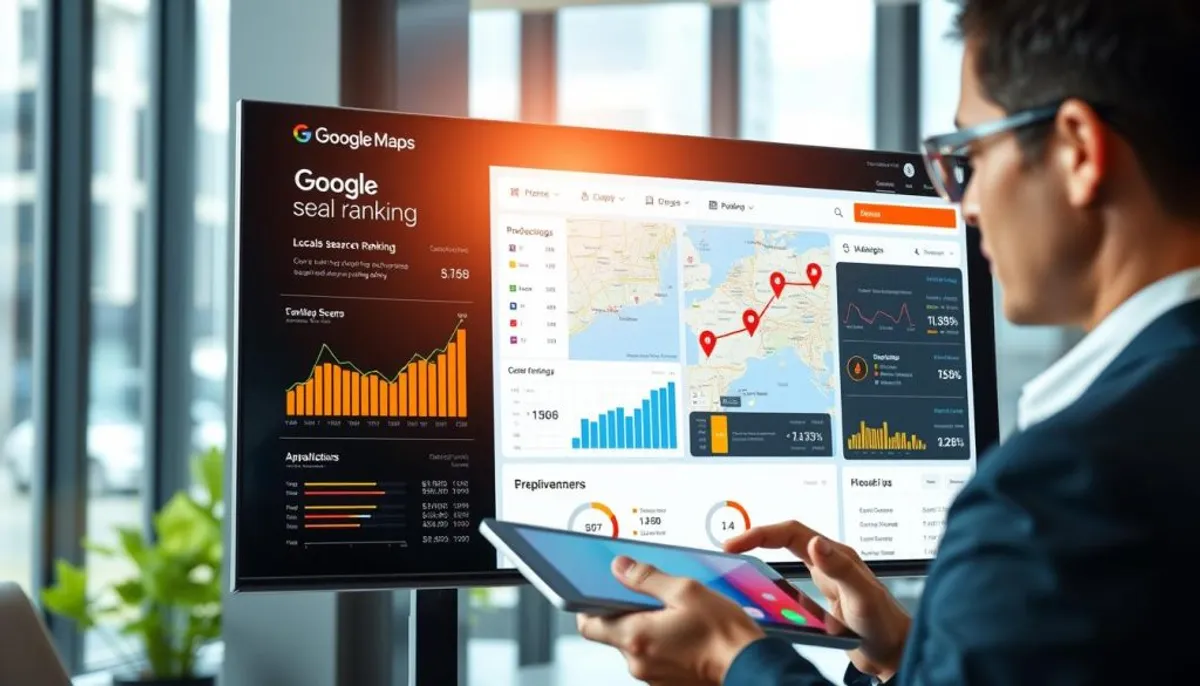
Geo-grid scans graphically represent rankings throughout a city, illustrating areas of strength and weakness. Conversely, custom pin drops cater to precise service area analysis, moving beyond broad zip-code generalizations. Local Falcon excels with its visual clarity in geo-grid mapping, while GMB Radar stands out for its customizable location assessments, permitting detailed audits.
Competitor tracking and side-by-side comparisons
Competitor analysis is enhanced with side-by-side comparisons, uncovering dominant areas and revealing untapped opportunities. A comprehensive local SEO tracker will archive competitor performances, simplifying trend comparisons and strategic planning. Both Local Falcon and GMB Radar provide exceptional competitor insights, as evidenced in their product features and customer reviews.
Scheduled scans, white-label reporting, and API access
Timed scans automatically monitor trends, offering proof of improvements over intervals. Agencies benefit from white-label reports, which GMB Radar notably supplies, emphasizing brand-centric offerings and affordability. API functionalities cater to businesses with multiple locations or custom requirements, enabling broad scalability and seamless analytics integration.
Additional practical features
- Credit-based or usage pricing for flexible costs, useful for irregular scan volumes.
- Browser and locale emulation to mirror real user queries and device contexts.
- Review monitoring and basic profile protection to catch issues that affect map rankings, features offered by platforms like Localo.
- Clear visuals and easy export options so teams act on findings quickly.
Selecting a Google Maps rank checker or local SEO rank tracker should be grounded in your workflow needs. Opt for solutions renowned for user-friendliness and support. The significance of straightforward, useful visualizations and dependable data transcends the allure of elaborate interfaces, especially when enhancing local online presence is the goal.
| Feature | Local Falcon | GMB Radar | Localo / Pro Tools |
|---|---|---|---|
| Geo-grid visuals | High-resolution visual grids for neighborhood insights | Visual grids plus flexible custom pin drops | Grid support with added profile protection |
| Custom location scans | Pin-based scans for precise service areas | Strong custom location options and credit model | Custom scans with review monitoring |
| Competitor comparisons | Side-by-side competitor tracking and trend views | Competitive intel and testimonials highlighting this feature | Competitor monitoring bundled with alerts |
| Scheduled scans | Recurring scans with export | Recurring scans and credit-based scheduling | Automated scans plus profile alerts |
| White-label reporting | Available for agencies | Explicit white-label options at agency pricing | Reporting with client-facing templates |
| API access | API for integrations and dashboards | API offered for scaled use | APIs and webhooks for automation |
| Pricing model | Subscription tiers | Credit-based, pay-as-you-go flexibility | Subscription with usage add-ons |
| Extra features | Strong UX and support | Affordable entry point and white-label focus | Review monitoring and profile protection |
Popular tools and how they differ
Selecting the ideal map rank tracking software fundamentally transforms your approach to local SEO. This comparison elucidates differences across leading platforms, tailored for freelancers, agencies, and large-scale enterprises.
Local Falcon stands out for its intuitive visual geo-grids and detailed heat maps. Lauded by agencies for features like multi-location tracking, comprehensive competitor insights, and API integrations. These visual reports are indispensable for identifying coverage gaps and demonstrating client progress from broader national to detailed neighborhood scans. Notably, its customer service excellence and consistent updates are frequently highlighted for their reliability.
GMB Radar appeals to those seeking cost-effectiveness with its credit-based system and adaptable geo-grid scans. It includes unique features like pin-dropping for custom locations, schedule-manageable scans, and customizable reporting options. Flexible pricing accommodates small teams with scalability in mind, while a 300-credit trial assesses its precision. Especially favored by freelancers for its affordability and straightforward reporting.
Localo offers a complimentary Local Rank Checker alongside features that ensure profile security and visibility monitoring. Integrated tools for review posting and claim management cater to several Google Business Profiles. Implementing Localo’s advice on GBP enhancements and post strategies swiftly leads to tangible improvements, ideally serving small business needs.
Divergences become evident in scale and operational flow. Agencies gravitate towards platforms offering batch scanning, customizable reports, and API connectivity for streamlined reporting automation. Freelancers prefer straightforward interfaces and affordable pricing strategies. Conversely, multi-location corporations require robust APIs and cohesive campaign management for extensive listing administration.
Consideration should be given to comparing capabilities such as geo-grid precision, competitor surveillance, scheduling flexibility, and review management effectiveness. Initiating trial scans to determine the most fitting google maps ranking tool or google maps rank checker for your process is advisable. Importantly, strong customer assistance and ongoing product evolutions are crucial for sustained success in map rank tracking.
How to run effective map rank tracking campaigns
Begin with a strategic approach. Select keywords reflecting customer search behaviors, such as “plumber near me” or “emergency electrician [city].” Before initiating scans, map these keywords to precise service areas.
Define target keywords and service-area locations
Catalog both primary and auxiliary queries tied to each location. Incorporate the vernacular of customers from reviews and interactions to improve your keyword selection. Identify pivotal locales: your central office, areas with high activity, and regions where competitors are prevalent. Employing a robust local SEO rank tracker facilitates a competitive analysis of these areas.
Set up geo-grid density based on city size and competition
In urban centers, opt for denser grids, contrasting with less crowded grids for suburban regions. For significant metropolitan areas, enhance sampling near public transportation and key commercial zones. Utilize tools like Local Falcon and GMB Radar for tailoring grid density and placement, achieving extensive neighborhood insights.
Automate scans, interpret trend reports, and act on insights
Implement routine scans to monitor weekly dynamics and detect periodic variations. Analyze heat maps and trend analyses to identify areas requiring attention and note positive changes. A Google Maps ranking tool that automates these scans streamlines the process, providing consistent data for client reports.
Convert findings into actionable strategies. Focus on updating Google Business Profile details in areas with poor rankings. Incorporate geo-targeted content, FAQs, and structured data to fill in missing elements. Enhance local presence through more citations and gather reviews from areas showing lesser performance.
Adhere to a logical operation sequence: establish KPIs, proceed with an initial multi-point evaluation, make data-driven adjustments, and conduct follow-up scans to assess effects. Combine reports from your Google Maps ranking tool with comprehensible visual aids when showcasing progress to your clientele.
Interpreting rank data to improve local SEO
Without context, raw rank numbers are meaningless. Visual tools and straightforward lists transform grid scans into actionable strategies for teams. This process facilitates the transition from data analysis to achieving tangible results in defined locales.

From heat maps to opportunity lists: Heat maps identify areas of high demand and poor visibility. By integrating underperforming areas with search volume and user intent, one can craft a list of opportunities. This list should prioritize areas with consistent search behavior yet lacking in local search presence.
Correlation of GBP signals: Analyzing trends such as citation consistency and geographic content relevance can influence rankings collectively. Utilizing tools like a Google Places rank checker, pair observed position trends with metrics such as review quantities and citation stability. These correlations assist in strategizing whether to enhance reviews, improve directory accuracy, or update content.
Using competitor gaps: Comparative reports pinpoint specific localities where competitors outperform. Interpret these findings as strategic guides. Enhance your strategy by creating targeted local pages, increasing GBP photo uploads, and encouraging reviews within these critical zones. A dedicated local SEO rank tracker delineates areas where competitor strength and local interest diverge, simplifying strategic prioritization.
Initiate with a concise plan derived from the identified opportunities. Align each location with a singular focus: bolstering content, citations, or review volume. Employ consistent grid scanning to monitor the impact of implemented changes, identifying the most effective interventions.
How AI and GEO content scale local ranking efforts
Content that echoes the search behavior scales the local map rankings. Short, locale-focused pages grasp queries unseen by vast, generic service pages. This enhances relevance for Google Business Profile. It also elevates organic search results when used with google maps rank checker tools.
Why localized, long-tail content matters for map rankings
Search behaviors now include city names, districts, and intent-based phrases. Targeting such long-tail queries allows pages to frequently appear in local packs. This amplifies GBP signals. Moreover, it boosts click-through rates for mobile inquiries monitored by a local SEO rank tracker.
UnlimitedVisitors.io: scaling AI SEO, GEO, and LLMO content
UnlimitedVisitors.io crafts city, region, and country-specific pieces in thousands. Keywords, tone, and brand specifics are customizable. The resulting content appears natural. It seamlessly integrates into site structures, providing agencies a means to scale as map tracking software requirements balloon.
How UnlimitedVisitors.io uncovers keyword opportunities and clusters long-tail queries
By analyzing search trends, the platform groups related queries. Pages crafted around these clusters meet the users’ search intents. This strategy efficiently fills the coverage voids outlined by geo-grid scans. It elevates the insights offered by tools like Local Falcon and GMB Radar.
Metadata, schema.org, alt strategies, and mobile-ready formatting included in each article
Articles are fortified with metadata, schema.org markup, and strategic image alt texts. They are structured to be mobile-friendly, with succinct headings ensuring swift page loads. The uniformity in markup facilitates scalability while preserving quality across extensive local content implementations.
How automated SERP research and multi-model support speed up deployment
The content creation process is energized by automated SERP research incorporating real-world intents. The platform’s support for over 30 languages and diverse AI models empowers rapid deployment of localized efforts. Integrating this data with a google maps ranking tool and regular checks from a local SEO rank tracker yields a proactive loop. This cycle – identify voids, generate localized content, analyze performance, then refine and scale – cuts down execution time. It ensures uniformity in metadata and schema across thousands of outputs. Combined with map rank tracking tools, it propels a cycle that iteratively enhances local visibility.
Measuring ROI and reporting local SEO progress to clients
Begin reports with a distinct overview that illustrates the business’s initial standings and subsequent developments. Implement periodic assessments using a google maps rank checker or a local SEO rank tracker for consistent baseline and progression insights. Integrate these findings with visual elements for immediate comprehension.
Essential KPIs:
Analyze the distribution of visibility within your operational territory, quantifying it as the portion of geo-grid points showcasing the listing. Document enhancements in map pack positioning, particularly transitions into the local 3-pack and equivalent search engine results page attributes. Aggregate data on interactions such as clicks, calls, directions requests, and impressions by correlating Google Business Profile analytics. Demonstrate growth patterns over time using data from regular assessments.
Creating white-label reports that impress:
Merge polished data extractions from tools like Local Falcon, GMB Radar, or Localo with concise, automated summaries and recommendations. Incorporate heat maps, trend analyses, and comparative snapshots to evidence advancements at the neighborhood level. Opt for client-accessible terminology, explicating the effects of Google Business Profile modifications, citation formulations, or content developments on performance enhancements.
Case study framing:
Construct your narrative around tangible advancements. Begin with an analysis that may uncover areas of diminished visibility. Following concerted efforts on GBP enhancements, citation initiatives, and localized content strategies, subsequent assessments through a google places rank checker can unveil improvements in map visibility and increased queries for directions. Translate these modifications into projections of call volumes and potential revenue, employing historical conversion metrics.
Practical ROI calculation:
Transform incremental digital engagements and inquiries into potential leads by applying the client’s typical conversion ratio. Multiply the number of leads by the average income per lead for a revenue increase estimation. Present a straightforward depiction of projections and actualities, allowing clients to envisage a pragmatic, moderate financial benefit.
- Assumption: incremental clicks per month
- Conversion: percentage of clicks that turn into customers
- Value: average revenue per customer
- Result: projected monthly revenue uplift
Utilizing a local SEO rank tracker, coupled with heat maps and lucid calculations of ROI, bridges the gap between operational efforts and their commercial consequences. Ensure communications are concise, visually engaging, and aligned with forthcoming actions, preparing clients for future analytical revelations.
Conclusion
In this era, local visibility not only sustains but actually accelerates business growth. Utilizing tools such as a Google Maps rank checker, like Local Falcon or GMB Radar, becomes indispensable. Together with platforms like Localo for profile protection, they provide comprehensive insights. These tools offer the necessary heat maps and alerts for prompt action.
Employing a multi-point baseline scan through a local SEO rank tracker can delineate areas of strength in your GBP. It also highlights where you’re forfeiting searches to competitors. This insight is crucial for strategic positioning.
Integrating geo-grid scans into your routine unveils hidden opportunities. It allows you to identify and focus on neighborhoods ripe for your business but currently underserved. Adopting map rank tracking software for regular scans helps in documenting strategic wins. It also aids in monitoring competitor activities and reporting progress.
Pairing this rigorous data collection with the creation of localized, long-tail content escalates your relevance on Google. It extends your discovery on platforms powered by language learning models (LLM).
Begin with actionable steps: initiate a baseline scan using a budget-friendly tool. Options include GMB Radar’s complimentary credits or Localo’s gratis rank checker. Target neighborhoods that exhibit potential yet lack optimal visibility with specific GBP updates and local landing pages.
Enhance your content production through UnlimitedVisitors.io to embrace broader geographical coverage. The reevaluation of strategy through scheduled rescans with tools like Local Falcon or GMB Radar is essential. This process quantifies the impact of your efforts, correlating visibility improvements to tangible results such as calls and revenue.
For entities operating within the U.S., a strategic blueprint emerges. It combines the analytical prowess of a Google Maps rank checker with the expansive potential of GEO-scaled AI content. This synergy transforms a local SEO rank tracker into a cyclical engine of growth. It not only elevates discovery but also secures measurable business outcomes.